The Leadership of Emperor Gaozu Liu Bang
The Leadership of Emperor Gaozu Liu Bang
Hello, and welcome to all history enthusiasts out there! 😊 Today, we're diving into the leadership of Emperor Gaozu Liu Bang, one of the most dramatic figures in all of Chinese history. Born a peasant, Liu Bang rose to defeat the aristocratic military genius Xiang Yu and unify China under the Han Dynasty. His success was no stroke of luck — it was the result of extraordinary leadership that placed the right people in the right roles and empowered them to shine. In this post, we'll explore exactly how Emperor Gaozu Liu Bang moved an entire era, and what lessons his leadership holds for us today!
📋 Table of Contents
- Who Was Emperor Gaozu Liu Bang? — The Rise of a Peasant Emperor
- The Three Heroes of Han (漢三傑) — Zhang Liang, Xiao He & Han Xin Unmasked
- The Rascals of Pei County — Hidden Heroes with Humble Beginnings
- Xiang Yu vs. Liu Bang — The Decisive Difference in Leadership
- The Three Inferiorities (三不如) — Liu Bang's Most Famous Confession
- Emperor Gaozu Liu Bang's Lessons for Modern Leadership
- Conclusion — The Master LEGO Builder
1. Who Was Emperor Gaozu Liu Bang? — The Rise of a Peasant Emperor
Emperor Gaozu Liu Bang (漢高祖 劉邦, 256 BC – 195 BC) was the first commoner-born emperor in Chinese history. Born the son of a farmer, he served as a low-ranking local official called a "tingzhang" (亭長) during the final years of the Qin Dynasty. To those around him at the time, he was little more than a boastful, middle-aged man who enjoyed drinking and eating a little too much.
But when the tyranny of the Qin Dynasty reached its breaking point and the land fell into chaos, Emperor Gaozu Liu Bang raised an army in Pei County and set out on an incredible journey toward unifying China. His most formidable rival, Xiang Yu, was a brilliant general from a prestigious noble family — a man who outmatched Liu Bang in background, military talent, and raw power at every turn. And yet, in the end, it was Emperor Gaozu Liu Bang who prevailed. That reason is the heart of today's story.
Personally, when I first encountered Liu Bang's story, my reaction was: "Wait — is this actually possible?" A man with no education, no aristocratic pedigree, and no personal combat ability defeating the greatest warrior-lord of his age feels like a neighborhood soccer team beating the national champions. What Emperor Gaozu Liu Bang proved is that leadership isn't about personal credentials — it's about the ability to read people and assemble an organization.
2. The Three Heroes of Han (漢三傑) — Zhang Liang, Xiao He & Han Xin Unmasked
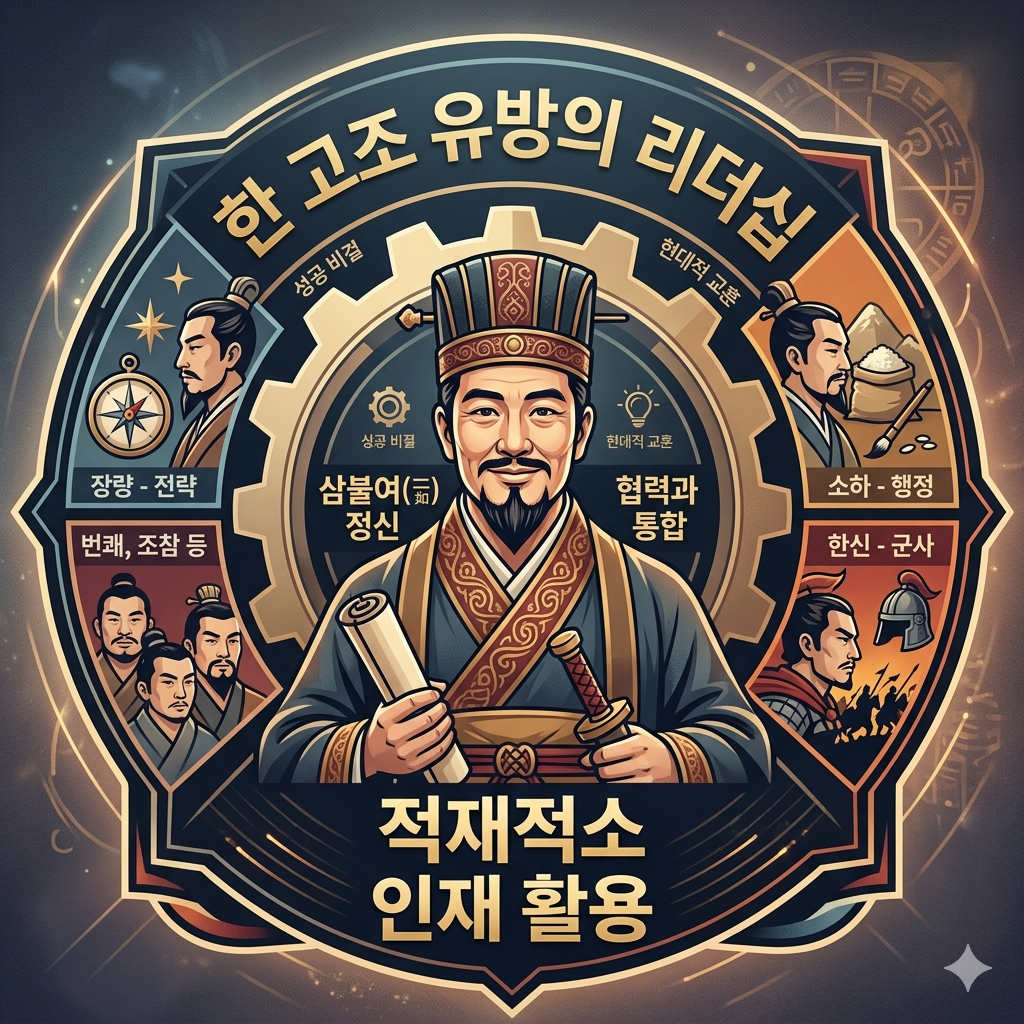
If you know even a little about Chinese history, you've likely heard of the Three Heroes of Han (漢三傑). This term refers to the three individuals who made the most decisive contributions to the founding of the Han Dynasty under Emperor Gaozu Liu Bang — namely Zhang Liang, Xiao He, and Han Xin. Each excelled in a completely different domain, and together their combination was extraordinary.
| Person | Core Role | Key Achievements & Traits |
|---|---|---|
| Zhang Liang (張良) | Grand Strategist | The master of strategy who guided battles from behind a curtain. Provided pivotal counsel at every critical turning point for Liu Bang. |
| Xiao He (蕭何) | Administration & Supply | Managed the entire rear operation throughout the war — logistics, food supply, and governance. Later became a legendary chancellor and the origin of the "Xiao Gui Cao Sui (蕭規曹隨)" proverb. |
| Han Xin (韓信) | Supreme Commander | An undefeated military genius. Famous for legendary tactics like the "Back-to-the-River Formation" (背水陣). Described as "peerless under heaven" (國士無雙). |
But here's the crucial point that often gets overlooked: these three were not all-around perfect individuals. Zhang Liang struggled to lead troops directly — he never commanded more than a few hundred men on his own, and he actually lost battles when given direct command. Xiao He, without Liu Bang, would likely have spent his entire life as a minor rural bureaucrat, and after Liu Bang's death he largely stood aside while Empress Lü seized power. Han Xin was a demon on the battlefield but a disaster in politics — he made enemies wherever he went.
This is what fascinates me most. The Three Heroes of Han were each geniuses in their own lane, but the person who created the environment in which their genius could fully flourish was Emperor Gaozu Liu Bang. Had anyone focused only on their weaknesses, none of them would ever have been used at all.
3. The Rascals of Pei County — Hidden Heroes with Humble Beginnings
Just as fascinating as the Three Heroes of Han is another group: the hometown friends of Emperor Gaozu Liu Bang, known informally as the "Pei County (沛縣) Gang." Figures like Cao Can, Zhou Bo, Fan Kuai, and Xiahou Ying would go on to become key founders of the Han Dynasty — but their starting points could not have been more unglamorous.
🐾 Fan Kuai — Dog Butcher turned War Hero
Later became Liu Bang's brother-in-law and one of his greatest generals. His dramatic rescue of Liu Bang at the Feast at Hong Gate (鴻門宴) is one of history's most celebrated moments.
🐴 Xiahou Ying — Stable Boy turned General
Once a mere horse handler, he risked his life repeatedly on the battlefield to save Liu Bang personally, eventually rising to become a celebrated military commander.
📜 Cao Can — Prison Warden turned Chancellor
A lowly jail official who succeeded Xiao He as chancellor, becoming the central figure in the "Xiao Gui Cao Sui" story. Proved himself equally impressive on the battlefield.
🎵 Zhou Bo — Funeral Flute Player turned Grand Marshal
Scraped by playing the flute at funerals, yet rose to become Taiwei (Grand Marshal of the military) — one of the most remarkable rags-to-power stories in Chinese history.
Honestly, looking at this lineup, you have to ask: "Are these really the founding heroes of an empire?" A dog butcher, a stable boy, a prison warden, a funeral flute player… Without Emperor Gaozu Liu Bang, none of them could ever have become what they became. Liu Bang saw through their rough exteriors and unremarkable backgrounds to the hidden brilliance within each one. He was, in every sense, a master at spotting raw diamonds.
4. Xiang Yu vs. Liu Bang — The Decisive Difference in Leadership
Any discussion of Emperor Gaozu Liu Bang's leadership must include a comparison with Xiang Yu. In terms of raw personal ability, Xiang Yu was in a completely different league. He was said to have the strength to uproot mountains and the spirit to overawe the world, and he was nearly unbeaten in actual combat. Liu Bang, by contrast, struggled in battle — and famously pushed his own children out of a carriage to escape faster during the Battle of Pengcheng. It's not exactly heroic.
| Category | Xiang Yu (項羽) | Liu Bang (劉邦) |
|---|---|---|
| Background | Prestigious Chu noble family | Commoner / farmer's son |
| Personal Combat | Near-invincible | Below average |
| Use of Talent | Failed to properly use even Fan Zeng | Masterfully deployed the Three Heroes + Pei Group |
| Winning Hearts | Brutal massacres and plunder | Won the people with the Three Articles of Law |
| Outcome | Encircled at Gaixia, died by suicide | Crowned first Emperor of the Han Dynasty |
Xiang Yu's fatal weakness was his inability to utilize even his greatest advisor, Fan Zeng. He fell for a disinformation scheme planted by Liu Bang and dismissed Fan Zeng in suspicion — and that was the beginning of the end. Meanwhile, Emperor Gaozu Liu Bang even turned Han Xin — formerly one of Xiang Yu's own men — into his supreme commander.
Modern management studies consistently cite Xiang Yu as a case study in the failure of ego-driven, talent-dependent leadership, while Emperor Gaozu Liu Bang is praised as a model of collaborative, talent-leveraging leadership that reversed a seemingly impossible disadvantage. The fact that this lesson remains just as relevant two thousand years later is remarkable, don't you think?
5. The Three Inferiorities (三不如) — Liu Bang's Most Famous Confession
After founding the Han Dynasty, Liu Bang held a grand banquet at Luoyang for all his founding meritorious subjects. As the feast warmed up, ministers began boasting about why Liu Bang had defeated Xiang Yu. Emperor Gaozu Liu Bang listened patiently, then spoke up himself. What followed became one of the most celebrated passages in all of Chinese history — known as the "Three Inferiorities" (三不如, Sān Bùrú).
— Sima Qian, Records of the Grand Historian (史記), Annals of Gaozu —
"For devising strategies in the command tent to secure victory a thousand li away, I am inferior to Zhang Liang.
For governing the state, comforting the people, and ensuring that supply lines are never cut, I am inferior to Xiao He.
For commanding a million soldiers, winning every battle, and capturing every fortress, I am inferior to Han Xin.
Yet I was able to make use of these three heroes — and that is why I hold all under heaven."
These words are far more than modesty. Publicly acknowledging that your subordinates surpass you requires enormous psychological courage and self-assurance as a leader. Liu Bang understood precisely that his role was to be the "assembler," and he grasped instinctively that trusting and empowering domain experts was the path to total victory for the whole organization.
The second half of that statement is equally striking. By pointing out that Xiang Yu had a brilliant advisor in Fan Zeng but failed to use him, Emperor Gaozu Liu Bang made it crystal clear: the ability to deploy talent is itself the supreme skill of leadership. It's no wonder this quote still opens leadership seminars around the world today.
🙋 Frequently Asked Questions (Q&A)
Q. Among the Three Heroes of Han, whom did Liu Bang trust most?
A. Xiao He is generally considered the person Liu Bang trusted most deeply. Xiao He was the only member of the Three Heroes who had been by Liu Bang's side since the Pei County days, and after the war he was granted the highest honor — the most food-tax fief of any subject (7,000 households).
Q. Why did Han Xin meet such a tragic end?
A. After the wars ended, Han Xin's lack of political instincts led him to repeatedly invite misunderstanding and suspicion. He was ultimately executed on orders of Empress Lü (呂后). His extraordinary military genius stood in stark contrast to his complete blindness to the mechanics of power.
Q. What were the "Three Articles of Law" (約法三章)?
A. When Liu Bang entered the Qin capital Xianyang, instead of imposing the complex and harsh Qin legal code, he announced just three simple rules: death for murder, punishment for injury, punishment for theft. This single act won him the hearts of the common people almost instantly and is regarded as one of the most brilliant political moves in Chinese history.
6. Emperor Gaozu Liu Bang's Lessons for Modern Leadership
Looking at the leadership of Emperor Gaozu Liu Bang through a modern lens, his approach can be distilled into three core principles that remain powerfully relevant today.
The LEGO analogy fits perfectly here. Having a lot of great bricks doesn't automatically produce a great creation. You need someone who knows how to combine them in extraordinary ways. The top-tier blocks of the Three Heroes of Han, the rough-cut gems of the Pei County gang — it was Emperor Gaozu Liu Bang's knowledge of where each piece belonged that made the empire of Han possible.
The same principle applies in the modern world. The most important person on a team is rarely the most talented individual — it's the leader who knows how to combine diverse talents into something greater than the sum of its parts. That's why the startup world says a great team matters more than a great idea. Two thousand years ago, Emperor Gaozu Liu Bang already proved that truth in the most consequential arena imaginable.
7. Conclusion — The Master LEGO Builder
Today we took a deep look at the leadership of Emperor Gaozu Liu Bang. To sum it up: Liu Bang was not a leader of exceptional personal ability. But when it came to recognizing the value of talent, placing people where they belonged, and willingly acknowledging those who surpassed him — he stands among the greatest leaders in all of history.
The Three Heroes of Han — Zhang Liang, Xiao He, Han Xin — were each geniuses in their own field, yet none of them could have claimed the world on their own. The same goes for the rascals of Pei County. The person who built them a stage and let them shine was Emperor Gaozu Liu Bang. So perhaps it wasn't Liu Bang who was the lucky one — perhaps it was those remarkable people who were fortunate enough to be found by a leader who could see what they were truly worth.
Think about the people around you right now. Chances are, there are uncut gems among them too. Why not try being a leader like Emperor Gaozu Liu Bang — one who discovers the brilliance in others and gives it room to grow? If you found today's post helpful, please subscribe and leave a comment! 😊
📌 Key Takeaways
✔ Emperor Gaozu Liu Bang was China's first commoner-born emperor — a man who won all under heaven through leadership, not personal power
✔ The Three Heroes of Han (Zhang Liang, Xiao He, Han Xin) each had major weaknesses, but Liu Bang maximized their strengths
✔ The Pei County group (Cao Can, Fan Kuai, Xiahou Ying, Zhou Bo) would never have made history without Liu Bang's eye for hidden talent
✔ The Three Inferiorities (三不如) — the courage to publicly acknowledge that your subordinates surpass you is Liu Bang's greatest virtue
✔ Liu Bang's ability to "assemble" talent remains one of the most celebrated leadership models in both ancient history and modern management