Hello, and welcome! Today we're diving deep into one of the most legendary moments in Three Kingdoms history — the Battle of Hefei. This wasn't just a tale of raw courage — it was the story of how 7,000 soldiers held off an army of 100,000. The real twist? The three generals at the center of it all — Zhang Liao, Yue Jin, and Li Dian — genuinely couldn't stand each other. So how did they pull off a miracle together? Let's unpack the leadership secrets and teamwork hidden inside this incredible battle. Whether you're a Three Kingdoms fan or a total newcomer, I promise you'll find this fascinating! 😊
- What Was the Battle of Hefei? — The Miracle of 7,000 vs. 100,000
- Zhang Liao — The Star of the Battle of Hefei, a Fearless Field Commander
- Yue Jin — A Soldier-Turned-General, the Unbreakable Wall of Defense
- Li Dian — The Cautious Aristocratic General, the Hidden Hero
- Why Three Rivals Fought Side by Side
- Cao Cao's Strategy — A Master's Art of Managing Conflict
- Modern Organizational Lessons from the Battle of Hefei
- Conclusion — Why the Battle of Hefei Still Resonates Today
① What Was the Battle of Hefei? — The Miracle of 7,000 vs. 100,000
The Battle of Hefei took place in 215 AD (the 20th year of the Jian'an era), when Sun Quan of the Kingdom of Wu led a proclaimed army of 100,000 troops against Hefei, a critical strategic stronghold of the Kingdom of Wei. The defenders? A mere 7,000 soldiers under the command of Zhang Liao, Yue Jin, and Li Dian — outnumbered by more than fourteen to one.
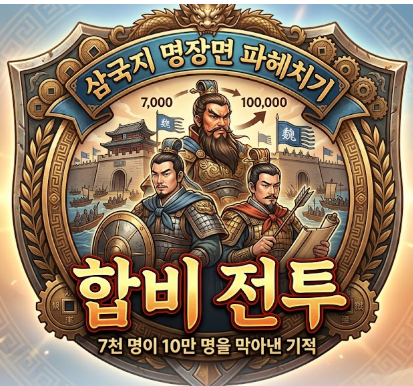
Yet the outcome was a stunning Wei victory. Sun Quan's massive force was routed in the Battle of Hefei, and Sun Quan himself barely escaped with his life. Years later, Emperor Cao Pi praised this engagement as an "unprecedented feat of generalship — 800 men shattering an army of 100,000."
| Category | Wei (Defenders) | Wu (Attackers) |
|---|---|---|
| Troops | ~7,000 | Claimed 100,000 |
| Commander | Zhang Liao · Yue Jin · Li Dian | Sun Quan (personal command) |
| Strategy | Preemptive raid + fortress defense | Siege and encirclement |
| Outcome | Victory | Retreat |
| Year | 215 AD (Jian'an Year 20) | |
② Zhang Liao — The Star of the Battle of Hefei, a Fearless Field Commander
Zhang Liao (張遼, 169–222 AD), courtesy name Wenyuan, originally served under Lü Bu. When Lü Bu was captured and executed by Cao Cao, Zhang Liao submitted to his new lord and quickly rose through the ranks despite being a late addition to Cao Cao's forces. His exceptional combat abilities propelled him to the very top tier of Wei's generals in a remarkably short time.
Zhang Liao's greatest strength was his explosive offensive power in open-field combat. At the Battle of Hefei, the moment he read Cao Cao's sealed orders, he wasted no time — he personally led 800 hand-picked warriors in a dawn raid, cutting through the enemy formation, threatening Sun Quan's command center directly, and shattering Wu's momentum in a single stroke. The name "Zhang Liao of Hefei" became so feared that, according to historical records, Wu children would stop crying at the mere mention of it.
Of course, Zhang Liao had a weakness too — his aggressive nature carried the risk of reckless overcommitment. Cao Cao understood this well, which is exactly why he paired the cautious Li Dian alongside Zhang Liao as a safety check. Even the most brilliant general needs a counterbalance — don't you think that's a timeless insight?
③ Yue Jin — A Soldier-Turned-General, the Unbreakable Wall of Defense
Yue Jin (樂進, ?–218 AD), courtesy name Wenqian, had one of the most remarkable rise-from-the-bottom careers among all of Cao Cao's generals. He started as an ordinary soldier and, through sheer courage proven across dozens of battles, climbed step by step all the way to the rank of senior commander — a true self-made man of the battlefield.
Yue Jin's greatest strengths were his ironclad grip over his troops and his defensive endurance. At the Battle of Hefei, per Cao Cao's sealed orders, Yue Jin was assigned to hold the fortress. The reason Zhang Liao and Li Dian could fight so freely outside the walls was precisely because Yue Jin stood firm behind them like an immovable rampart. He wasn't the general who stole the spotlight, but without him the entire battle would have collapsed.
When Yue Jin passed away in 218 AD, Cao Cao posthumously awarded him the title "Marquis Wei" (威侯). There are also records of Cao Cao praising Yue Jin alongside Yu Jin and Zhang Liao in a memorial to Emperor Xian. Yue Jin never chased glory — he simply did his job perfectly. Isn't that, perhaps, the kind of person every organization needs most?
④ Li Dian — The Cautious Aristocratic General, the Hidden Hero
Li Dian (李典, ?–?), courtesy name Mancheng, came from a powerful local clan that had commanded thousands of retainers and private soldiers for generations. This made him fundamentally different from the other generals — he wasn't a direct employee of Cao Cao so much as an allied partner bringing his own independent powerbase to the table.
Li Dian was known for his scholarly disposition and deeply cautious temperament. Historical records note that he "disliked warfare," a characterization that tells you everything about how he approached conflict. He resented Zhang Liao's reckless aggression and made little effort to hide it. Yet at the Battle of Hefei, Li Dian set his personal feelings completely aside.
— Said by Li Dian when Zhang Liao proposed the offensive sortie. This is an actual recorded statement from the Sanguozhi (Records of the Three Kingdoms).
That single declaration became the moral foundation on which the Battle of Hefei victory was built. Li Dian didn't reluctantly tag along — he marched out with the mature professionalism of someone who could separate duty from personal feeling. During the fighting, he even shot and killed the Wu general Song Qian with an arrow. Quiet and unsung, I believe Li Dian was the true hidden hero of the Battle of Hefei.
⑤ Why Three Rivals Fought Side by Side
So why were these three men so at odds with each other? In short: Yue Jin and Li Dian had served Cao Cao from the early days, but Zhang Liao was a former enemy officer who joined late — and by the time of the Battle of Hefei, he had already outranked both of them. From their perspective, they were being asked to serve under someone who had once been their adversary.
And Yue Jin and Li Dian weren't exactly close with each other either. Yue Jin was a self-made man who had clawed his way up from the bottom, while Li Dian was born into an established aristocratic clan — their backgrounds, values, and worldviews could hardly have been more different.
| General | Background | Strengths | Weakness |
|---|---|---|---|
| Zhang Liao | Former Lü Bu officer (late recruit) | Field assault, surprise raids | Risk of reckless overreach |
| Yue Jin | Self-made from common soldier | Troop control, defensive holding | Limited ability to turn a battle around |
| Li Dian | Aristocratic clan (allied partner) | Cautious judgment, ranged combat | Tendency toward passivity |
The tension among the three wasn't simple personal animosity — it was a structural clash born from fundamentally different origins, values, and interests. And fascinatingly, it was precisely that clash which forced each man's role into sharp focus during the Battle of Hefei.
⑥ Cao Cao's Strategy — A Master's Art of Managing Conflict
Cao Cao's sealed orders amounted to a single sentence: "Zhang Liao and Li Dian shall go out and engage the enemy; Yue Jin shall hold the fortress; Xue Ti shall not take part in combat." Packed into that brief instruction is Cao Cao's entire philosophy of talent management.
Cao Cao didn't assign these three together despite knowing they clashed — he assigned them together because he knew it. When you fill a team with people who are too similar, groupthink and complacency set in. It's the friction between different strengths, backgrounds, and perspectives that keeps a team sharp and adaptive.
Worth noting too: Cao Cao deliberately excluded Xue Ti, the civil officer who delivered the orders, from the chain of command. By clearly separating the role of messenger from the role of commander, he cut off any possibility of Xue Ti overstepping his authority. That's a leadership principle that holds up just as well in a modern boardroom as on an ancient battlefield.
⑦ Modern Organizational Lessons from the Battle of Hefei
The Battle of Hefei happened 1,800 years ago, yet it offers remarkably sharp lessons for today's professionals and organizational leaders. Here are the three core takeaways I find most powerful.
First: pair authority with accountability. Li Dian initially opposed Zhang Liao's plan to sortie. But once he was assigned to go out and fight alongside him, he could no longer just criticize from the sidelines — he had skin in the game. Organizations move when the people who make decisions are also the people who live with the consequences.
Second: define the objective with absolute clarity. Without Cao Cao's explicit directive — "go out and repel the enemy" — the three generals would likely have spent their energy arguing over whether to attack, hold the fortress, or retreat altogether. Unclear goals turn conflict into a zero-sum war of attrition instead of a shared effort.
Third: turn difference into competitive advantage. Three Zhang Liaos would have charged recklessly into destruction. Three Li Dians would have never left the walls. It was the interlocking of three radically different strengths that made the impossible possible. Diversity isn't a liability to be managed — it's the engine of breakthrough performance.
- Never separate decision-making from accountability — the lesson of Li Dian
- A clear shared objective converts conflict into collective energy — the lesson of Cao Cao's orders
- Diversity is not a weakness but the ultimate weapon — the lesson of Zhang Liao, Yue Jin, and Li Dian's roles
⑧ Conclusion — Why the Battle of Hefei Still Resonates Today
Today we explored the Battle of Hefei and its three protagonists — Zhang Liao, Yue Jin, and Li Dian. The Battle of Hefei, where 7,000 defeated 100,000, was never just a military achievement. History is showing us that when three people — who are different, uncomfortable with each other, and frankly don't even like each other — commit fully to their individual roles, miracles become possible.
Zhang Liao's blazing aggression, Yue Jin's mountain-like defensive resolve, Li Dian's cool-headed judgment. When these three interlocked, victory in a seemingly unwinnable battle became reality. And behind it all was Cao Cao's exceptional leadership — knowing each man's differences better than they knew themselves, and placing each one exactly where he belonged.
Right now, in your own organization, there may be colleagues who rub you the wrong way, teammates whose styles clash with yours. But maybe — just maybe — that friction is exactly what will make your team stronger. The Battle of Hefei continues to be told and retold 1,800 years later because it contains a universal truth about people and organizations that never goes out of date. 😊
#BattleOfHefei #ZhangLiao #YueJin #LiDian #ThreeKingdoms #WeiKingdom #ThreeKingdomsHistory #CaoCaoLeadership #ThreeKingdomsGenerals #HistoryBlog